 Image 1 of 1
Feel more informed and confident about prenatal ultrasounds with this easy-to-understand educational handout.
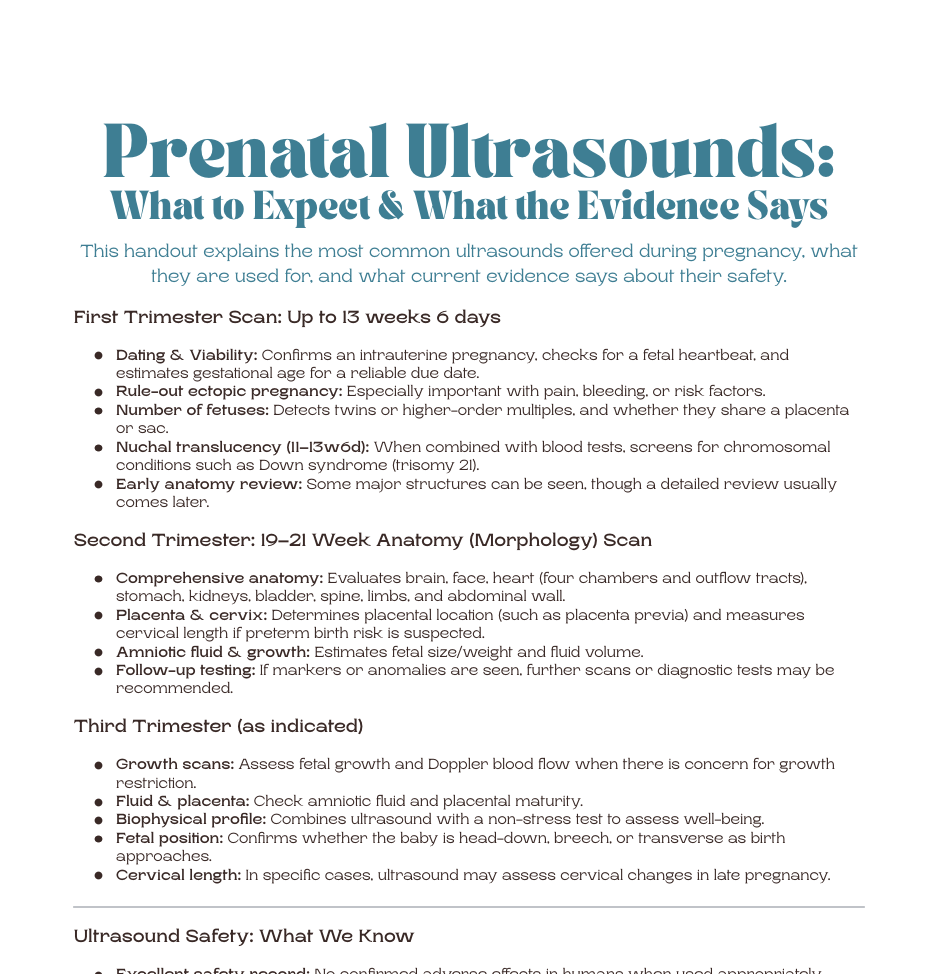
Prenatal Ultrasounds: What to Expect & What the Evidence Says walks you through the most common ultrasounds offered during pregnancy, what each scan is designed to assess, and what current evidence tells us about ultrasound safety.
Inside, you’ll learn about:
First-trimester ultrasounds — dating and viability, ectopic pregnancy evaluation, multiples, nuchal translucency screening, and early anatomy.
The 19–21 week anatomy scan — what providers evaluate, including the baby’s brain, heart, spine, limbs, organs, placenta, cervix, fluid, and growth.
Third-trimester ultrasounds — when growth scans, Doppler, fluid assessment, biophysical profiles, fetal position, or cervical assessment may be recommended.
Ultrasound safety — what we know about diagnostic ultrasound, the ALARA principle, Doppler use, and the difference between medically indicated and keepsake scans.
Benefits, risks, and uncertainties — including what the evidence says about dating, growth monitoring, developmental concerns, and the possibility of false-positive findings.
Practical questions to ask your provider so you can better understand why a scan is being recommended and what the results may mean for your care.
A valuable resource for anyone who wants to understand prenatal ultrasounds without getting overwhelmed by medical jargon.
Use this guide to prepare for conversations with your healthcare provider and feel more empowered throughout your pregnancy.
Feel more informed and confident about prenatal ultrasounds with this easy-to-understand educational handout.
Prenatal Ultrasounds: What to Expect & What the Evidence Says walks you through the most common ultrasounds offered during pregnancy, what each scan is designed to assess, and what current evidence tells us about ultrasound safety.
Inside, you’ll learn about:
First-trimester ultrasounds — dating and viability, ectopic pregnancy evaluation, multiples, nuchal translucency screening, and early anatomy.
The 19–21 week anatomy scan — what providers evaluate, including the baby’s brain, heart, spine, limbs, organs, placenta, cervix, fluid, and growth.
Third-trimester ultrasounds — when growth scans, Doppler, fluid assessment, biophysical profiles, fetal position, or cervical assessment may be recommended.
Ultrasound safety — what we know about diagnostic ultrasound, the ALARA principle, Doppler use, and the difference between medically indicated and keepsake scans.
Benefits, risks, and uncertainties — including what the evidence says about dating, growth monitoring, developmental concerns, and the possibility of false-positive findings.
Practical questions to ask your provider so you can better understand why a scan is being recommended and what the results may mean for your care.
A valuable resource for anyone who wants to understand prenatal ultrasounds without getting overwhelmed by medical jargon.
Use this guide to prepare for conversations with your healthcare provider and feel more empowered throughout your pregnancy.